

Last updated on August 17th, 2026
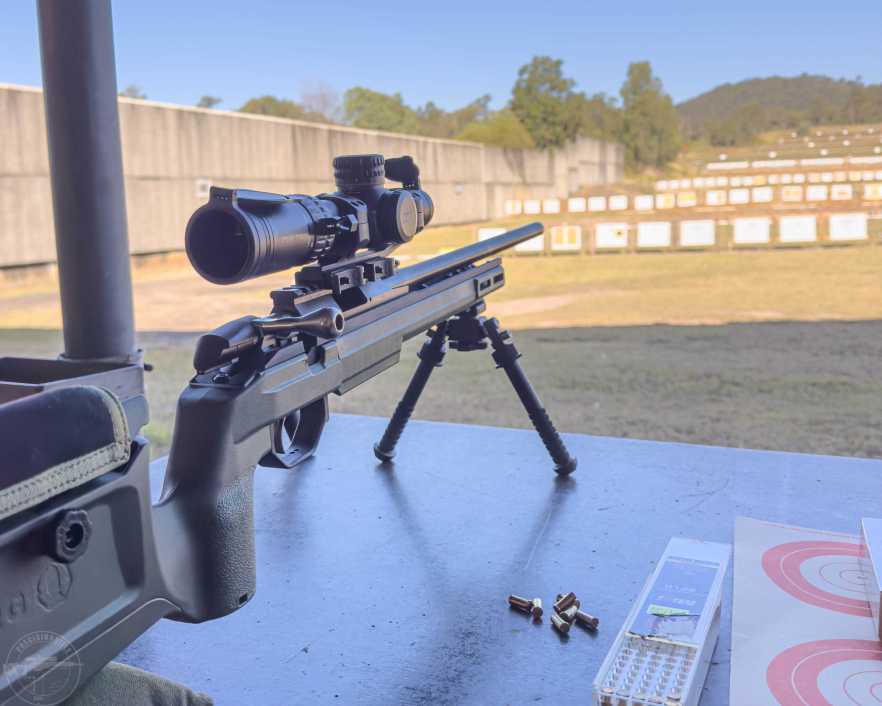
This ZeroTech Trace ED 1-10×24 review began with the scope on a borrowed Wedgetail Industries MPR Mini and continued across multiple rifles, including my Tikka T1X. I used it in the field and lower light, worked with the RMG-L reticle from 1x to 10x, dialled elevation and returned to zero, and carried it through scrub where it picked up ordinary knocks.
The Trace ED is the most capable ZeroTech LPVO I have used. The image is flat and natural at 1x, remains detailed at 10x, and the locking elevation turret is genuinely useful rather than decorative. It is also a 727g, 34mm-tube optic with fixed 100m parallax, so it belongs on a rifle that can use its features rather than one being built around minimum weight.
Field verdict: choose the Trace ED 1-10×24 when you want one LPVO to cover fast close-range aiming and more deliberate shots at distance. Its glass, RMG-L reticle and elevation controls justify the step above the Thrive line; its weight, price and tighter 10x eye box are the costs.

How I Tested the Trace ED
| Area | Review evidence |
|---|---|
| Initial rifle | Borrowed Wedgetail Industries MPR Mini |
| Later setup | Moved between multiple rifles, including a Tikka T1X |
| Conditions | Field carry, bright light, lower light and scrub |
| Optical use | Both-eyes-open 1x through deliberate 10x observation |
| Mechanical use | Elevation dialling and repeated return to the established zero |
| Limit | Practical field checks, not a calibrated tall-target laboratory test |
That distinction matters. The review supports direct conclusions about this sample’s view, controls, zero return and field handling. It does not establish statistical reliability across every scope or replace a measured tracking test over the full adjustment range.
ZeroTech Trace ED 1-10×24 Specifications
| Specification | Current official listing |
|---|---|
| Magnification | 1-10x |
| Objective | 24mm |
| Focal plane / reticle | First focal plane RMG-L, illuminated |
| Tube | 34mm, 6061-T6 aluminium |
| Adjustment | 0.1 MRAD; 10 MRAD per revolution |
| Elevation travel | 34 MRAD listed usable travel |
| Windage adjustment | 15 MRAD internal adjustment |
| Elevation control | Pull-to-unlock with zero stop |
| Windage control | Capped |
| Parallax | Fixed at 100m |
| Eye relief | 94mm |
| Field of view at 100m | 39.1m at 1x; 3.91m at 10x |
| Length / weight | 263.1mm / 727g |
| Weather rating | IPX7 |
ZeroTech’s current product table also gives 35 MRAD as internal elevation adjustment while separately listing 34 MRAD of elevation travel. I use the more conservative 34 MRAD figure when discussing usable travel and recommend confirming the current manual for the exact production version.


Build, Mounting and Included Covers
The 34mm tube gives the scope a substantial feel and enough room for the adjustment system. Fit and finish on the review sample were clean, the magnification control moved smoothly, and the removable throw lever made it easier to move through the broad 10:1 zoom ratio without shifting my grip.
The alloy flip-up covers are one of the better included accessories. They rotate to the preferred resting position and protect the lenses without the loose fit of a generic cap. They also add width around the ocular and objective, so check bolt handle, rail and accessory clearance before tightening the rings.
A 34mm tube requires the correct scope rings or one-piece mount. I set eye relief at higher magnification, where the view is least forgiving, then checked the 1x position from standing, kneeling and supported positions. Mounting only from a bench can hide a poor stock or eye-relief fit.
Optical Performance at 1x
At 1x the Trace ED gives a wide, largely distortion-free image. I did not see the distracting fisheye effect that makes some high-ratio LPVOs feel as though the scene bends while the rifle moves. Colour remained neutral and the view merged naturally enough with the unaided eye for fast target acquisition.
The illuminated central feature makes both-eyes-open use easier, but this is still an optical scope with an eye box rather than a true red dot with effectively unlimited eye relief. A poor mount position or an inconsistent cheek weld will still produce shadow. Once set up correctly, the 39.1m field of view provides useful awareness around the target.

Optical Performance at 10x and in Low Light
At 10x the image retained useful brightness, contrast and fine detail across the field. I did not observe obvious chromatic aberration in the reviewed conditions, including hard edges against strong backlight. The extra magnification made smaller targets easier to resolve without the washed-out, soft high end found in some ambitious budget LPVOs.
Late in the day, the ED glass and coatings kept the image useful after cheaper optics often begin losing contrast. The 24mm objective still limits the exit pupil to 2.4mm at 10x, so physics has not been suspended: lowering magnification can produce an easier, brighter view as light fades.
The eye box tightens toward 10x and asks for a repeatable position. I found it manageable from supported and field positions, but a shooter expecting red-dot freedom at maximum power will be disappointed. Ten power is best treated as the deliberate end of the scope, not the setting to leave selected for every shot.
RMG-L First Focal Plane Reticle
The RMG-L is designed around the two very different jobs an LPVO must perform. At low power, the illuminated centre and heavy outer references draw the eye quickly. As magnification increases, the finer elevation and windage references become visible enough for measured holds and corrections.
Because it is in the first focal plane, those subtensions remain valid throughout the zoom range. That is a real advantage over a second focal plane LPVO when the shooter moves between 4x, 6x and 10x instead of using holds only at maximum power. The cost is that a detailed FFP reticle can look small at 1x without illumination.
In my use the central illumination was bright and clean enough to support fast aiming without washing out the surrounding reticle. At higher magnification I preferred a lower setting or no illumination so the target detail remained uncluttered.

Elevation Turret, Zero Stop and Windage
The elevation turret pulls upward to unlock and presses down to lock. That movement is positive, and it is difficult to mistake the state by touch. Clicks are 0.1 MRAD, with 10 MRAD per revolution and markings that are easy to follow without counting several tiny lines from memory.
I dialled elevation for longer targets and returned to the established zero repeatedly without observing a shift. The zero stop made the return simple and prevented me from losing the base reference. This was a practical dial-and-return check during normal use, not a calibrated tall-target measurement of exact click value.
Windage is capped, which matches the way I use this optic: dial elevation when needed and hold wind in the reticle. A shooter who dials both axes constantly may prefer exposed windage, but the cap is safer while moving through scrub and protects the setting from an unnoticed bump.

Recoil, Field Carry and Finish
The Trace ED moved between rifles and retained the behaviour I expected after recoil and handling. It also took several ordinary knocks while being carried through scrub without an observed change in zero or a mark that affected function. The covers and control layout made it easier to protect the optic without wrapping it in a bulky separate system.
At 727g, the scope adds stability to a supported rifle but is noticeable when carried. Include the 34mm mount when calculating the complete system. A scope that looks acceptable on a product page can push a compact rifle into a very different balance once the mount and accessories are fitted.
Trace ED 1-10×24 vs Other ZeroTech Options
| Model | Best reason to choose it | Main trade-off |
|---|---|---|
| Trace ED 1-10×24 | Best glass and controls of these ZeroTech LPVO choices | 727g, 34mm mounting and premium price |
| Thrive HD 1-8×24 | Simpler, lighter value LPVO with hunting reticles | SFP, capped turrets and no zero stop |
| Thrive HD 1-4×24 prism | Compact etched-reticle unit with integrated mount | Only 4x and still 545g |
| Trace Advanced 4-24×50 | Long-range glass, parallax control and detailed holdover reticle | Not a close-range 1x optic |
The Trace ED is the correct step when the rifle needs more than a simple point-and-shoot LPVO. The Thrive HD is the rational value choice for capped-turret hunting use. The variable prism is the compact specialist. None wins every role, which is why the ZeroTech model-by-model guide labels both evidence and buyer fit.
What the Trace ED Does Well
- Natural, wide 1x image with little distracting distortion in the reviewed sample.
- Useful detail, contrast and colour at 10x.
- RMG-L reticle works as a fast centre at low power and a measured grid at higher power.
- Locking 0.1 MRAD elevation turret and practical zero stop.
- Capped windage suits field carry and reticle-based wind holds.
- Included alloy covers and removable throw lever are genuinely useful.
- Retained zero and returned as expected during the recorded field use.
Drawbacks
- A 727g scope plus 34mm mount can make a compact rifle top-heavy.
- Eye position becomes more critical at 10x.
- Fixed 100m parallax is less flexible for very close precision rimfire work.
- A detailed FFP reticle is smaller at 1x without illumination.
- The locking turret and MRAD grid add cost and complexity that a set-and-forget hunter may not need.
- My dial checks were practical checks, not a calibrated full-range tracking test.
Who Should Buy It?
| Shooter | Fit | Reason |
|---|---|---|
| General-purpose centrefire owner | Strong | One optic covers fast 1x use and deliberate 10x shots |
| Practical rifle or competition shooter | Strong | FFP MRAD reticle, locking elevation and useful field of view |
| Open-country hunter | Good if weight is accepted | Glass and magnification are strong; complete setup is not light |
| Close-range-only rifle | Over-specified | A red dot, prism or lighter 1-6x may be faster and cheaper |
| Bench-only long-range rifle | Compare upward | A 4-24x or 5-30x adds parallax control and more target detail |
Setup and Use Tips
- Use a quality 34mm mount and verify rail engagement before setting eye relief.
- Set the dioptre against a blank background before judging optical sharpness.
- Establish eye relief at 10x from realistic positions, then verify the 1x presentation.
- Choose an illumination level that defines the centre without blooming.
- Set and verify the zero stop only after a confirmed live-fire zero.
- Keep the reticle and turret in MRAD throughout the ballistic workflow.
The MIL vs MOA guide explains why matching reticle, turret and ballistic data is more important than arguing that either unit is inherently superior.
Frequently Asked Questions
Is the ZeroTech Trace ED 1-10×24 a true 1x LPVO?
ZeroTech lists a 1x low end, and my sample produced a flat, natural view suitable for both-eyes-open shooting. Perceived unity magnification still depends on dioptre, eye relief and the individual shooter’s vision.
Does the Trace ED hold zero?
The reviewed sample retained zero through use on multiple rifles and ordinary field handling. It also returned to the established zero during my elevation dialling. Those are direct observations, not a universal guarantee or laboratory endurance test.
Is the RMG-L reticle too busy?
At 1x the illuminated centre dominates and the finer references recede. At higher power the grid becomes more useful. A shooter who wants only a duplex-style centre may prefer the Thrive HD PHR4 or G4 instead.
Is 10x useful with a 24mm objective?
Yes in good light, and the reviewed glass held useful detail at 10x. As light fades, the 2.4mm exit pupil makes a lower setting easier to use. Maximum magnification is an option, not an obligation.
Is it worth the step over the Thrive HD 1-8×24?
It is when you will use the FFP reticle, locking MRAD elevation turret, zero stop and optical improvement. If the rifle will be zeroed once and used mainly with simple holds, the lighter and less expensive Thrive HD can be the more rational purchase.
Final Verdict
The ZeroTech Trace ED 1-10×24 is the standout LPVO in the current PrecisionRifle ZeroTech coverage. It combines a convincing 1x view, useful 10x image, adaptable RMG-L reticle and one of the better elevation controls I have used in this price area. The sample retained zero and returned correctly through the practical checks recorded here.
Its limits are equally clear: 727g is substantial, 34mm mounting costs more, and 10x demands a consistent eye position. Put it on a rifle that can use the dialling system and magnification range and those compromises make sense. Put it on an ultralight close-range rifle and much of the value is wasted.


 PRECISIONRIFLE